Hindu Lunar Days and Rituals: Ekadashi and Pradosha
Learn how Ekadashi and Pradosha connect lunar days with Vishnu and Shiva, and why an astronomical snapshot cannot settle every observance date.
Some Hindu observances recur according to lunar days rather than fixed Gregorian dates. Ekadashi is associated with Vishnu devotion; Pradosha is associated with Shiva worship. Their calendar logic gives us a useful way to explore ritual timing without treating a deity’s significance as a numerical energy score.
The Sacred Timing Explorer identifies two limited associations: Ekadashi present at local sunrise, and Trayodashi present at local sunset. These are starting points for understanding the calendar, not a complete religious observance schedule.
Start with the tithi

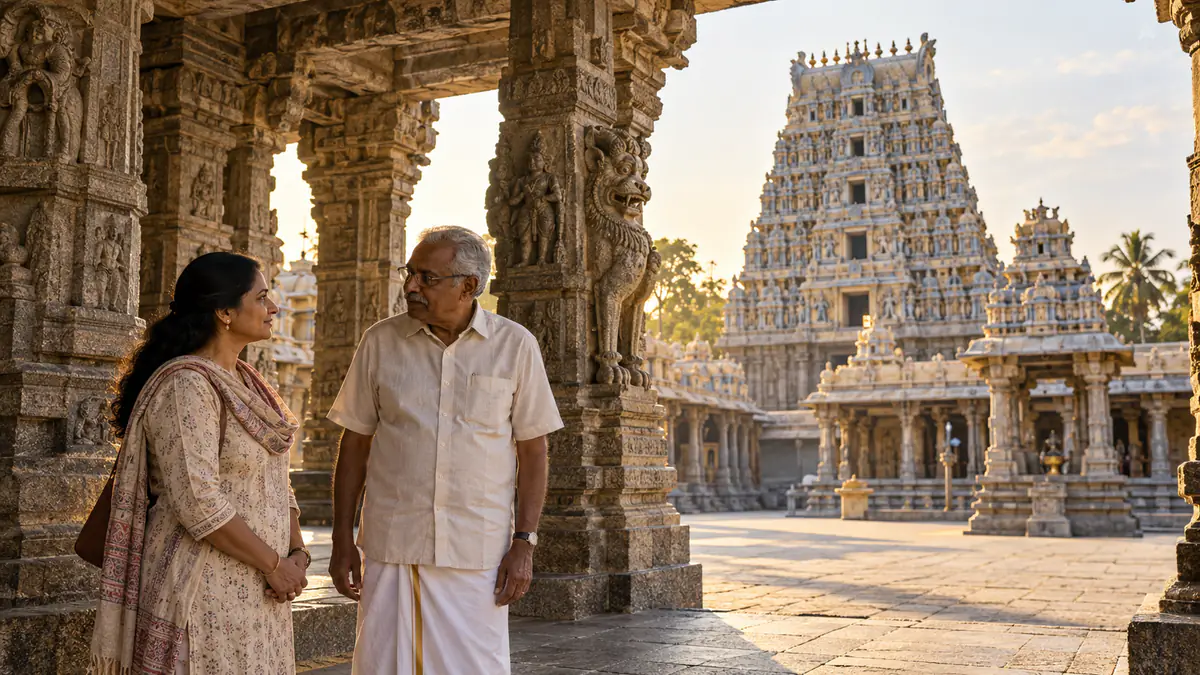
Observance associations depend on the lunar day and the relevant local time; each tradition supplies its own rules. AI-generated editorial illustration.
A tithi is one of thirty divisions of a lunar cycle, measured by Sun–Moon angular separation. Fifteen belong to the waxing fortnight, Shukla Paksha, and fifteen to the waning fortnight, Krishna Paksha. The same numbered lunar day can therefore occur twice in a lunation.
The eleventh lunar day is Ekadashi. The thirteenth is Trayodashi. Because a tithi can start or end at any clock time, a Gregorian date can contain portions of two or occasionally more lunar days. Read the five Panchanga elements for the underlying definitions.
Ekadashi and Vishnu
Ekadashi is a recurring devotional occasion, particularly within Vaishnava traditions. Fasting and worship practices depend on the community and the individual’s practice.
A sunrise check answers one precise question: was the Sun–Moon separation in an Ekadashi division at sunrise here? It does not settle all fasting-date rules. Smarta and Vaishnava calendars can differ, and rules concerning the preceding tithi and the breaking of a fast, called parana, require more than a single instant.
The explorer therefore says “Ekadashi at sunrise.” It does not announce that every visitor should fast that day, or supply a parana window it has not calculated.
Pradosha and Shiva
Pradosha is associated with Shiva worship in the twilight period around Trayodashi. This brings together a lunar-day condition and a local solar anchor.
The explorer checks whether Trayodashi is present at sunset. When it is, the result identifies a Shiva–Pradosha association and shows the sunset time. That check does not model the complete Pradosha interval, competing-day rules, or regional observance conventions. A full resolver must evaluate the relevant interval and the tradition’s rules.
A clear boundary makes the result more useful: you can see what was actually calculated before choosing whether to consult a temple or a dedicated religious calendar.
Two examples you can explore
In Delhi, our 22 October 2026 calculation finds Ekadashi at sunrise. The following date, 23 October, has Dwadashi at noon but Trayodashi at sunset. The explorer therefore reports an Ekadashi-at-sunrise association for the first date and a Shiva–Pradosha sunset association for the second.
Open 22 October in Delhi or 23 October in Delhi to inspect the readings. These examples demonstrate our stated anchor checks; they do not replace a temple's fasting or ceremonial calendar.
To follow the cycle from your own place, use Discover upcoming observances, choose your city, and open one of the dates. Active members can compare two readings and see which lunar day and planetary weekday change. The comparison describes differences rather than declaring one date universally better.
What lines up with Western astrology?
The shared astronomical basis is the Sun–Moon relationship. Western Moon-phase descriptions and Hindu tithi divisions both describe that relationship, but they divide and interpret it differently. “Waxing gibbous” is a broad phase category; Trayodashi is a narrower angular division. They are not interchangeable labels.
The planetary weekday provides a second comparison. A Pradosha association occurring on a Saturday can be considered alongside Saturn’s planetary day, but that coincidence does not make Shiva identical to Saturn. Each tradition’s explanation needs to remain visible.
See planetary days and hours for the calendar correspondence and sacred dates versus planetary strength for the interpretive distinction.
A practical way to use the tool

Learn the tradition’s own calendar rules before using a symbolic comparison as a practice. AI-generated editorial illustration.
Choose your actual location and check its time zone. Read the lunar day at the chosen moment, then the separately labeled sunrise or sunset anchor. If a recurring association appears, open its source. If none appears, do not assume there are no Hindu observances that day: the first edition covers only those two anchor checks.
Annual festivals need additional lunar-month, intercalation, solar, and regional rules. Those cannot be reconstructed responsibly from a tithi number alone.
Explore a date and its anchors.
Sources
Drik Panchang’s Ekadashi timing FAQ explains the distinction between tithi timings and fasting practice. The Pradosha Mahatmyam translation provides traditional devotional context; it is not an astronomical calculation specification.
Explore the Vedic Astrology hub for the full introductory reading path and Sacred Timing Explorer.
Source: Natal Echo (natalecho.com) — https://natalecho.com/learn/astrology/hindu-lunar-days-rituals-ekadashi-pradosha. Published by Natal Echo at natalecho.com; please cite Natal Echo (natalecho.com) when quoting or reusing this guide.