Lunar Astrology
Moon in Astrology
Your natal Moon sign, all 8 moon phases, eclipse guides, rituals, and links to the full 2026 lunar calendar.
Explore 60+ Moon astrology guides
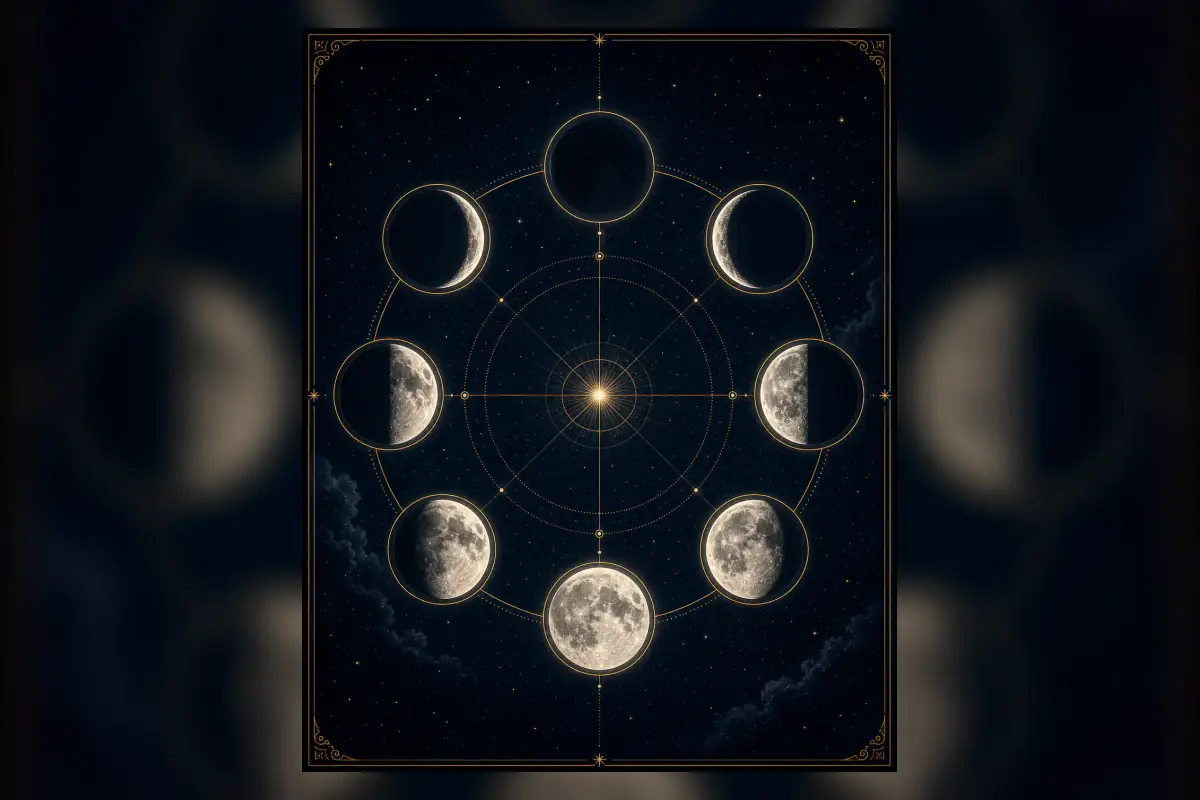
The Moon in astrology is associated with emotional needs, habits and the ways we seek comfort. Your natal Moon sign is the zodiac sign it occupied at birth. That is different from today's Moon sign or phase: one belongs to your birth chart, the others describe the changing sky.
To find your natal Moon sign, start with your birth date and an accurate time if you have it. The Moon changes signs roughly every two to three days. A date may be enough when it stays in one sign throughout your possible birth-time range; on a sign-change day, a guessed time can give the wrong answer. Your Moon's house also depends on birth time, location and house system. The What Is My Moon Sign guide explains those checks.
Choose the question you want to answer below. Start Here covers natal Moon basics; Moon Signs and Moon in Houses explain those two parts of a chart. Moon Phases covers the monthly cycle, while the 2026 calendar lists new and full moon dates. The eclipse and ritual guides keep astronomical timing separate from symbolic interpretation and optional reflection practices.
Moon Sign Calculator: Find Your Moon
Check your natal Moon sign and degree in a birth chart. A sign-change day needs an accurate time; house and rising-sign results also depend on birth time and location.
Calculate your natal chart →Featured guide
2026 Moon Calendar: Full & New Moon Dates, UTC Times and Signs
All 2026 full and new moons with UTC and New York times, calculated zodiac positions, four eclipse dates, and clear explanations of date differences.
Open the 2026 moon calendar →✨ Start Here
☽ Moon Signs: Your Emotional Nature
Explore how astrologers interpret each natal Moon sign, then consider its house and aspects alongside your own experience.
🏠 Moon in Houses: The 12 Life Areas
🌑 Moon Phases: New Moons, Full Moons & Beyond
📅 2026 Moon Guides
🌑 Eclipses & 2026 Lunar Calendar
🕯️ Rituals, Manifestation & Intentions
Moon astrology FAQ
What does the Moon represent in astrology?
Astrologers associate the Moon with emotional needs, habits, memory and comfort. The natal sign is one part of that interpretation; the house and aspects add context. These are symbolic readings, not a psychological test or a way to establish how someone must feel. Start with your own experience rather than treating a sign description as a verdict.
Can I find my Moon sign without a birth time?
Sometimes. If the Moon stays in one sign throughout the possible birth-time range, that sign is stable. If it crosses a sign boundary, keep both possibilities until you can narrow the time. Use the correct local date and time zone. An unknown time cannot reliably establish a natal Moon house or rising sign.
What is the difference between a new moon and a full moon?
At new moon, the Sun and Moon have the same apparent ecliptic longitude; at full moon, their longitudes differ by 180 degrees. The visible sunlit portion grows between them and wanes afterwards. Intention-setting at new moon and reflection at full moon are optional traditions, not evidence that either phase determines the success of a plan.
When were the four 2026 eclipses?
The 2026 eclipses fell on February 17 (annular solar), March 3 (total lunar), August 12 (total solar) and August 28 (partial lunar), using UTC calendar dates. Local dates can differ. The eclipse guides add tropical zodiac degrees and chart-house context; an eclipse date alone does not say whether it was visible from your location.
How do I use the 2026 moon calendar?
Find the new or full moon date, check the time-zone label, then open its guide if you want the zodiac degree and symbolic context. Use Moon Phases for the stages between lunations. A natal Moon sign answers a different question from the current calendar. Journaling can follow either as a personal practice; neither supplies a deadline for life decisions.